Cambridge Civic Journal Forum

July 24, 2013

Online Voter Registration Search Now Available

Filed under: Cambridge,elections — Tags: — Robert Winters @ 11:06 am

The City of Cambridge Election Commission is proud to announce the launch of the new Online Voter Registration Search. Voters will now be able to access a voter registration search page which has been added to the Election Commission website at https://www.cambridgema.gov/election/voterregistrationsearch.aspx.

Voters will be prompted to enter their first name, last name and date of birth. If they are registered, they will be able to check the address where they are registered, active or inactive status, political party affiliation, elected officials and their polling place information, including a link to a map of the polling place.

For residents who are not registered in Cambridge, there is a link to a voter registration form that can be printed and mailed to the Election Commission.

For voters in the 5th Congressional district, the deadline to register to vote for the Oct 15, 2013 Special Primary is Sept 25, 2013 at 8pm. For all Cambridge voters, the deadline to register for the Nov 5, 2013 Municipal Election is October 16, 2013 at 8pm.

July 16, 2013

The Do’s and Don’ts of Cambridge Municipal Election Campaigns

Filed under: 2013 Election,Cambridge,elections — Tags: , — Robert Winters @ 2:31 pm

All’s fair in love and war and politics

Well, actually no. There are time-honored traditions in Cambridge municipal election campaigns – some based on tradition and basic courtesy, some based on the law, and some based on the practical politics of elections conducted using Cambridge’s proportional representation (PR) system with its transferable ballots. Here are some rules, regulations, courtesies, and practical suggestions for running a proper PR election campaign in way that will earn you friends and help you to not make enemies.

Don’t engage in negative campaigns. Unless you plan on sailing past the election quota with a surplus of #1 votes, you may need those transfer ballots from defeated candidates. If you attack another candidate whose supporters might have also liked you, then those voters may not list you as a next preference on their ballots. You may need those transfers, so if you must be critical try to be decent about it.

Introduce the competition. There is a long history of candidates attending campaign events for other candidates. Everybody benefits from this and it’s a necessary part of our election system where voters can rank as many candidates on their ballot as they please. If another candidate is very popular and earns a surplus of votes, you may want a share of those transferred surplus ballots. More significantly, if that other candidate is defeated while you’re still in the running, you will definitely want to be a beneficiary when all of that candidate’s ballots become available for transfer. This is one of the most important facts about PR elections. On the other hand, if you see a viable candidate, particularly an incumbent, coming to all your events, you may have every reason to believe that he is rooting for your defeat so that he can get your ballots. So….

Be skeptical of other candidates trying too hard to be your "friend." There’s a good chance that your new friend will be nudging you toward defeat while staying ahead of you in the Count. These new friends will usually be incumbents, but not always. On a positive note, some of your fellow candidates will become your good friends for decades to come. The shared experience of a political campaign can be a bonding experience. It can also leave hard feelings that may never go away.

Don’t steal the spotlight. If you attend the campaign events of other candidates, and you definitely should do this with candidates who have any sort of common appeal, you should never do any overt campaigning at another candidate’s event other than asking for a #2 vote behind the featured candidate. You should always be mindful of when it’s appropriate to campaign and when it’s not appropriate. Voters recognize and respect courtesy.

Those who try to assemble slates of candidates do this for themselves – not for you. That said, you might still derive benefits from being on a slate of candidates, especially if the slate is the invention of the candidates and not of some organization with their own agenda. The Cambridge Civic Association (CCA) successfully used slates of endorsed candidates from the 1940s through the end of the 20th Century to help elect candidates who might not necessarily have won with independent campaigns. It can be very effective, but you should probably be very skeptical of any group who promises you the world for being on their slate. It can also hurt you to be associated with an unpopular group.

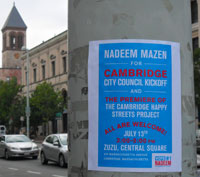
MistakeDon’t put your flyers, bumper stickers, or any other campaign materials on utility poles, mailboxes, or any other location other than private property. Not only is this illegal, it is guaranteed to infuriate your fellow candidates. Voters also tend to respond negatively to this kind of aggressiveness. Bear in mind that it’s usually not the candidates who do this, but their loyal and overly zealous supporters. So… instruct your supporters to not do you any favors like this. If you discover any of your campaign stuff in places they don’t belong, remove it promptly.

Find your base. Every successful candidate builds his or her campaign on a base of voters who are most likely to cast their #1 votes for that candidate. If you have no base and think you can win on some kind of "broadcast" campaign where you deliver your brilliant message to a rapt audience who swoon on the magnificence of your words, think again. Most voters will cast their ballots based on some kind of affinity with a candidate. This might be based on some pressing issue of the day or the promise of great new ideas, but it is more likely that the basis will be such things as living in the same neighborhood, sharing some racial or ethnic heritage, sharing the same gender or sexual orientation, having attended high school together, or having spent time in the same places. Once you have identified your base of most likely voters, you can build from there.

SignsSigns don’t vote. This is one of the oldest sayings in Cambridge politics and probably everywhere else. During the days of rent control, this was especially true since landlords would often post signs outside their building even if all the tenants in the building were voting for the other candidates. It’s probably a good idea for new candidates to display some signs and bumper stickers just to get their names out in public. Like it or not, many voters will comment after an election that they never heard of you even if your name was on the ballot.

Spend your money wisely. There are some horror stories of Cambridge candidates who were essentially unknown who spent considerable money on citywide mailings to every registered Cambridge voter and who received fewer votes than the number of signatures on their nomination papers, i.e. less than 50. If you find yourself spending several hundred dollars per #1 vote, you are definitely doing something terribly wrong. Campaigns are not generally cheap, but you have to use your resources wisely by identifying your most likely voters and strategically going after them. This means maintaining a good database and making effective, repetitive contact with your most likely voters. As the story told by Tip O’Neil goes, "people like to be asked." There are some incumbent candidates who run very effective campaigns on a shoestring budget.

Be consistent. If you tell one voter how you feel about some controversial matter and then tell another voter something that contradicts this, you can generally count on those two voters or other voters eventually discovering your inconsistency. The last thing you need in a local election is for the word to spread that you’re dishonest. So just be truthful even if you think it might lose you a vote. You will likely make up for that with the votes of other people. If you choose to tell people only what you think they want to hear, they will see through you like clear glass – and they will also likely vote for another candidate who more sincerely agrees with them.

Above all, be a human being. Never forget that most voters will vote for candidates who they see as representative of themselves, and most people have primarily positive views of themselves. If you come across as arrogant, you will only earn the votes of arrogant voters. If people see the humanity in you, this will always work to your benefit. It will also be a lot easier to live with yourself – regardless whether you win or lose the election.

Any additions? This is just the first draft of what will likely be a growing list. – Robert Winters

July 15, 2013

Special State Election Calendar – Markey Seat

Filed under: elections — Tags: — Robert Winters @ 8:39 pm

SPECIAL STATE ELECTION

Representative in Congress for Massachusetts
5th Congressional District*
(to fill vacancy caused by the resignation of Edward J. Markey)

Calendar of Events Deadline Dates
  Party Candidates Non-Party Candidates
Last day for a person running in the state primary to enroll in a party or for a person running only in the state election to unenroll from a party, except for newly registered voters. May 15, 2013 May 15, 2013
5:00PM last day and hour for submitting nomination papers to local Registrars of Voters or Election Commissioners for the certification of signatures. July 31, 2013 Sept 17, 2013
Certification of nomination papers must be completed. Aug 12, 2013 Sept 26, 2013
5:00PM last day and hour for filing nomination papers, including enrollment certificate, with the Secretary of the Commonwealth. Aug 14, 2013 Oct 1, 2013
5:00PM last day and hour for filing withdrawals of or objections to all nomination papers and certificates of nomination with the Secretary of the Commonwealth. Aug 16, 2013 Oct 3, 2013
5:00PM last day and hour for filling vacancies caused by withdrawals for primary candidates. Aug 20, 2013  
PLEASE NOTE: ALL DATES AND DEADLINES BELOW ARE THE SAME FOR ALL CANDIDATES
Last day to register voters for the state primary; registration hours 9:00AM to 8:00PM (except in towns under 1500 registered voters, registration hours 2:00-4:00PM and 7:00-8:00PM). Sept 25, 2013
State Primary Oct 15, 2013
5:00PM last day and hour for filing withdrawals of or objections to nominations made at the state primary and for filing written acceptances by write-in or sticker candidates who won in the state primary with the Secretary of the Commonwealth. Oct 21, 2013
5:00PM last day and hour for filling vacancies caused by withdrawals at the state primary. Oct 22, 2013
Last day to register voters for the state election; registration hours 9:00AM to 8:00PM (except in towns under 1500 registered voters, registration hours 2:00-4:00PM and 7:00-8:00PM). Nov 20, 2013
State Election Dec 10, 2013

2,000 certified signatures required for all candidates.

Please see "A Candidate’s Guide to Special Elections" available from:
Elections Division
One Ashburton Place, Room 1705
Boston, Massachusetts 02108-1512
(617) 727-2828 or (800) 462-VOTE
For information about campaign contributions
and expenses please contact:
Federal Election Commission
999 East Street N.W.
Washington, D.C. 20463
(800) 424-9530
*Middlesex County     Suffolk County Worcester County
Arlington
Ashland
Belmont
CAMBRIDGE:
Wd. 3, Pct. 2A
Wd. 4, Pcts. 2, 3
Wds. 6, 7, 8, 9
Wd. 10, Pcts. 1, 2
Framingham
Holliston
Lexington
Lincoln
MALDEN
MEDFORD
MELROSE
Natick
Sherborn
Stoneham
Sudbury
Pcts. IA, 2, 3, 4, 5
WALTHAM
Watertown
Wayland
Weston
Winchester
WOBURN
REVERE
Winthrop
Southborough

June 25, 2013

Janneke House to Run for City Council

Filed under: 2013 Election,Cambridge,City Council,elections — Tags: , — Robert Winters @ 10:44 pm

Janneke HouseJanneke House is pleased to announce her candidacy for Cambridge City Council.

Janneke is the daughter of a police officer and a school teacher and said: "My parents taught me about the importance of public service and working for the common good."

"I grew up in a middle-class family that struggled at times. I know from personal experience how important it is to get a good education, have a roof over your head, and secure a job that pays a living wage. I will make sure that the City of Cambridge does everything it can to ensure the best possible opportunities for every citizen."

Ms. House graduated from the University of Utah with a Masters of Urban Planning, worked for Mayor Rocky Anderson in Salt Lake City on economic development and small business planning. She was the first Executive Director of Cambridge’s Local First and is currently Director of Member and Community Relations for the Kendall Square Association.

Janneke House is a proud Democrat who believes in the Democratic foundation of social justice, including living wages to support families, housing availability for all levels of life’s progress and a voice for everyone in their government.

She serves on the board of Emerge Massachusetts, an organization that trains and recruits women to run for office and is an active member of the Ward 8 Committee and the Cambridge Democratic City Committee.

"In my political and professional life, I support pragmatic solutions, consensus building, and good civil discourse. I recognize the strengths that make Cambridge attractive to employers, students, residents, and workers from all over the world."

"With a new city manager, a retiring councilwoman, and the continuing evolution of our neighborhoods, this election is the voters’ opportunity to elect new and collaborative voices on the Council."

"I want to put my experience in local government, business, economic development, urban planning, and community building to work as a full-time City Councillor for the residents of Cambridge."

The Janneke House for City Council kickoff will be held on Sunday July 14, 2013, 4-6pm at Tasty Burger in Harvard Square. Everyone is welcome.

For more information visit: www.votehouse.org.

Cambridge Candidate Pages – 2013

2013 Campaign Event Listings and Candidate Forums     [Send event listings to —-]

May 26, 2013

Voter Turnout by Age – November 2011 vs. November 2012 Cambridge Elections

Filed under: 2011 Election,2012 election,elections — Tags: — Robert Winters @ 11:51 pm

The overall percent voter turnout (including active and inactive registered voters) in the November 2011 municipal election was 26.4%. The overall percent voter turnout in the November 2012 federal election was 71.9%. Turnout always varies considerably by age. The chart below shows the percent turnout by age in four-year increments. The municipal election is in blue and the federal election in maroon.

Voter Turnout 2011 and 2012

November 19, 2012

Nov 19, 2012 Cambridge City Council Agenda highlights

Filed under: Cambridge,cycling,elections,planning — Tags: , , , — Robert Winters @ 11:42 am

Nov 19, 2012 Cambridge City Council Agenda highlights

Here are some items that jump out as worthy of comment:

City Manager’s Agenda #1. Transmitting communication from Robert W. Healy, City Manager, relative to Council Order Number 10, dated 5/23/2011, regarding Biogen return to Cambridge.

Biogen Idec Inc. intends to soon relocate its headquarters to Cambridge where it now has a substantial presence. As the Manager’s letter states, "The remaining outstanding barrier is the zoning requirement that a cafeteria be located on the ground floor of the building and open to the public at least 20 hours per week." This seems like a completely reasonable accommodation, especially if the local business association makes a parallel effort to create affordable food options in the immediate area. Most people would likely choose to eat in a restaurant than in the cafeteria of a life sciences building anyway. Perhaps that existing provision in the zoning code is a vestige of the days when Kendall Square had vanishing dining options. That’s no longer the case, though the provision of affordable dining options could still use some attention.

Resolution #15. Resolution on the death of William M. Hogan, Jr.   Councillor Maher

William Hogan was a former Cambridge City Councillor and first Vice Mayor under the Plan E Charter. He was the last surviving councillor elected in 1941 in Cambridge’s first PR election under the Plan E Charter adopted the previous year. He died at the age of 100. He would have been about 27 when he was elected (in 1939) and 31 when he left office. He ran unsuccessfully for reelection in 1943. He was among the last elected councillors-at-large in 1939 under the previous charter and the first under the new Plan E charter.

Resolution #25. Thanks to City staff for their work on Election Day.   Mayor Davis

Order #16. That the City Manager confer with the Election Commission to make information publicly available on wait times throughout Election Day and the number of booths at each precinct.   Councillor Cheung and Councillor vanBeuzekom

Though I had to wait over 40 minutes in line to vote this year, when I got to the front of the line I saw only efficiency and courtesy from the the poll workers at the City Hall Annex. Though things may have run faster with more booths, the real slowdown was caused by the presence of several additional nonbinding ballot questions that most people did not have an opportunity to read prior to voting. If it were my call, I would allow voters the option to vote outside of the booths if they don’t mind doing so. The checking in, checking out, and inserting of ballots into the scanner go very quickly. The limiting factor is the number of booths. One of the great advantages of scannable paper ballots is that there is no strict limit on how many voters can simultaneously if there is some flexibility in where you can fill out your ballot. Mayor Davis’ appreciation of election workers stands in marked contrast to the recent bellyaching of one of her colleagues.

Order #1. That the City Manager is requested to investigate creating a pilot program for installing mini exercise stations on major walking routes throughout the city, perhaps at bus stops, subway stations and public parks.   Mayor Davis

Order #2. That the City Manager is requested to look into the installation of public drinking fountains at additional locations in the city – possibly working with the Cambridge Arts Council on interesting designs.   Mayor Davis

These are interesting and creative suggestions. Every such installation, however, will have to be maintained and that could be problematic. I’m inclined to believe that public parks and plazas would be a lot more appropriate than bus stops and subway stations.

Order #4. That the Cambridge City Council go on record urging the members of the Senate Ways and Means Committee to pass MA Senate Bill 2314, "An Act Relative to Plastic Bag Reduction."   Councillor vanBeuzekom

Order #10. That the City Manager is requested to instruct the Law Department to prepare language for an amendment to the Municipal Code to ban the use of polystyrene-based disposable food containers and to provide a waiver provision similar to the by-law of the Town of Brookline.   Councillor Cheung and Mayor Davis

I’m glad that there is attention being given to some of these more annoying aspects of waste management, especially the reduction of materials for which there are limited recycling options. It should be noted that consumers have always been able to avoid plastic bags simply by providing their own reusable bags when shopping. Regarding the banning of polystyrene food containers, don’t be surprised if some food vendors replace them by even more wasteful containers made of other plastics that rarely make it into the recycling stream.

Order #5. That the City Manager is requested to work with the appropriate city officials to explore the possibility of completing and submitting the Bicycle Friendly Community application by Feb 26, 2013 so that the City of Cambridge may be included in the next review cycle and join together with other communities in participating in the Bicycle Friendly Community program.   Councillor vanBeuzekom

As a daily cyclist, I continue to scrutinize the City’s decisions regarding safe accommodation for cyclists and transportation policies that often seem more rooted in hostility toward motor vehicle operators than in the promotion of good alternatives. The City does seem to be doing a better job in their design of on-street bike lanes, though they routinely err in their treatment of these lanes at intersections. State law requires that right-turning vehicles move as far right as possible before making their turn, yet the City often stripes bike lanes with a solid line right up to intersections. Unless a motor vehicle operator drives in the bike lane immediately before turning, there will be a greater risk of turning into a cyclist passing on the right – and many cyclists are oblivious to this danger. The City is also installing "cycle tracks" on some streets that will create significant conflicts at driveways and intersections and will most likely narrow travel lanes to the point where on-street cyclists wishing to maintain more than casual recreational speeds are endangered. I don’t expect these realities to be reflected in the City’s application, and City planners have been unresponsive in their cycle track juggernaut.

Order #9. Special Permit process pursuant to MGL 40A as it relates to the impact of re-filing a zoning petition on pending special permits or special permits that have been granted.   Councillor Kelley

Though I won’t speak to the merits of this Order, the confusion by city councillors over the recent "move to withdraw" the Yanow Petition indicated that a little more schooling on zoning regulations and procedures may be in order.

Order #11. That the Cambridge City Council go on record urging the members of the Massachusetts Committee on House Steering, Policy and Scheduling to pass MA House Bill 4165, "An Act Relative to Speed Limits."   Councillor vanBeuzekom

This legislation would reduce the speed limit within "thickly settled areas" and business districts from the current level of 30 miles per hour to 25 miles per hour. As a "thickly settled area", all of Cambridge would likely be covered by this reduced speed limit. While this would make sense in many Cambridge locations, especially on narrow streets with many parked cars, there are plenty of other streets where the existing 30mph speed limit makes more sense. This proposal is introduced every few years and is usually not supported by transportation engineers who argue that, in the absence of other factors, speed limits should be set according to prevailing speeds in order to minimize conflicts.

Order #20. That the City Manager is requested to confer with the appropriate city officials to explore the possibility of communicating appropriate storm preparedness through the website and text messages sent by the city.   Councillor vanBeuzekom

This is a good suggestion and consistent with the City’s long-standing practice of encouraging residents to help keep storm drains clear during and after winter storms. Having braved Sandy’s wrath on several occasions to clear the storm drains in my neighborhood, I think it would be very helpful if people were more aware of keeping these drains unobstructed. That means not only parking clear of the drains, but also picking up a rake and getting out there to help keep the drains clear.

Committee Report #1. A communication was received from Donna P. Lopez, Interim City Clerk, transmitting a report from Councillor David P. Maher, Chair of the Government Operations and Rules Committee, for a public meeting held on Oct 19, 2012 to discuss Community Benefits.

The report suggests that the City Council has a long way to go before really coming to terms with this issue. In simple terms, a community benefit is the money paid or benefit provided by a developer for up-zoning property. However, when city councillors are closely involved in deciding how these funds should be spent, the funds often go toward pet projects or priorities of individual councillors. The default option is often affordable housing. One of the more refreshing aspects of the Goody Clancy process for Kendall Square and Central Square has been the expanded definition of community benefits to include things like the exclusion of ground floor retail in the calculation of building densities, financial support for retail in the form of either reduced rent or outfitting the space, and the creation of public spaces for markets and other purposes. These and other ideas are welcome additions to the discussion of what community benefits might flow from permitting additional density in appropriate locations. This committee report only refers to housing and human services, and that’s far too limiting. The Government Operations Committee and Ordinance Committee would be well-advised to absorb the forthcoming recommendations regarding Kendall Square and Central Square before redefining what constitute community benefits and how any related funds should be disbursed. It should also be stated that when community benefits are tied to up-zoning proposals, there is the very real possibility that every such proposal will be granted as long as enough cash is put on the table – regardless if the proposal makes good planning sense. – Robert Winters

November 7, 2012

Cambridge Election Results: Nov 6, 2012

Filed under: 2012 election,Cambridge — Tags: — Robert Winters @ 10:43 am

State & Presidential Election Unofficial Results November 6, 2012
(Cambridge Totals Only – from City website)
Unofficial Results do not include Write-In, Auxiliary, Overseas Absentee or Provisional Ballots.

ELECTORS OF PRESIDENT AND VICE PRESIDENT Party Votes %
Johnson and Gray Libertarian 550 1%
Obama and Biden Democratic 41,991 86%
Romney and Ryan Republican 5,340 11%
Stein and Honkala Green-Rainbow 906 2%
SENATOR IN CONGRESS
Scott P. Brown Republican 7,463 15%
Elizabeth A. Warren Democratic 41,127 85%
REPRESENTATIVE IN CONGRESS
Fifth District
Edward J. Markey Democratic 21,048 90%
Tom Tierney Republican 2,297 10%
Seventh District
Michael E. Capuano Democratic 19,641 88%
Karla Romero Independent 2,690 12%
COUNCILLOR, Sixth District
Terrence W. Kennedy Democratic 38,657 100%
SENATOR IN GENERAL COURT
Middlesex and Suffolk District
Sal N. DiDomenico Democratic 18,915 100%
First Suffolk and Middlesex District
Anthony W. Petruccelli Democratic 6,775 89%
Thomas J. Dooley, III Republican 801 11%
Second Middlesex District
Patricia D. Jehlen Democratic 12,640 100%
REPRESENTATIVE IN GENERAL COURT
24th Middlesex District (Cambridge Only)
Tommasina Anne Olson Republican 177 7%
David M. Rogers Democratic 2,169 85%
James F. Gammill Open Innovative Government 207 8%
24th Middlesex District (Arlington, Belmont & Cambridge)
Tommasina Anne Olson Republican 4,420 20.5%
David M. Rogers Democratic 12,338 57.1%
James F. Gammill Open Innovative Government 4,857 22.4%
25th Middlesex District
Marjorie C. Decker Democratic 14,997 100%
26th Middlesex District (Cambridge Only)
Timothy J. Toomey, Jr. Democratic 7,752 69.2%
Thomas Michael Vasconcelos Republican 596 5.3%
Mike Connolly Progressive Independent 2,855 25.5%
26th Middlesex District (Cambridge & Somerville)
Timothy J. Toomey, Jr. Democratic 10,772 68.3%
Thomas Michael Vasconcelos Republican 1,010 6.4%
Mike Connolly Progressive Independent 3,968 25.2%
Write-in   16 0.1%
29th Middlesex District
Jonathan Hecht Democratic 7,361 100%
8th Suffolk
Martha Marty Walz Democratic 5,053 100%
CLERK OF COURTS, Middlesex County
Michael A. Sullivan Democratic 38,629 100%
REGISTER OF DEEDS, Middlesex Southern District
Maria C. Curtatone Democratic 37,423 100%
SHERIFF, Middlesex County (to fill vacancy)
Peter J. Koutoujian Democratic 34,430 88%
Ernesto M. Petrone Unenrolled 4,596 12%
STATEWIDE BALLOT QUESTIONS (For full text of the statewide ballot questions (questions 1-3), please see http://www.sec.state.ma.us/ele/ele12/ballot_questions_12/message12.htm
Question 1: Availability of Motor Vehicle Repair Information
Yes 35,841 88%
No 4,715 12%
Question 2: Prescribing Medication to End Life
Yes 30,909 68%
No 14,639 32%
Question 3: Medical Use of Marijuana
Yes 36,063 79%
No 9,564 21%
NON-BINDING PUBLIC POLICY QUESTIONS
Question #4:
Shall the state senator from this district be instructed to vote in favor of a resolution calling upon Congress and the President to: (1) prevent cuts to Social Security, Medicare, Medicaid, and Veterans benefits, or to housing, food and unemployment assistance; (2) create and protect jobs by investing in manufacturing, schools, housing, renewable energy, transportation and other public services; (3) provide new revenues for these purposes and to reduce the long-term federal deficit by closing corporate tax loopholes, ending offshore tax havens, and raising taxes on incomes over $250,000; and (4) redirect military spending to these domestic needs by reducing the military budget, ending the war in Afghanistan and bringing U.S. troops home safely now?
Yes 32,812 82%
No 7,134 18%
Question #5 (Wd 1, Wd 2 Pct 1, Wd 3, Wd 4 Pct 2, Wd 6, Wd 7, Wd 8, Wd 9, Wd 10, Wd 11)
Shall the state senator from this district be instructed to vote in favor of legislation that would allow the state to regulate and tax marijuana in the same manner as alcohol?
Yes 25,944 78%
No 7,294 22%
Question #5 (Wd 2 Pcts 2&3, Wd 4 Pcts 1&3, Wd 5)
Question #6 (Wd 1, Wd 2 Pct 1, Wd 3, Wd 4 Pct 2, Wd 6, Wd 7, Wd 8, Wd 9, Wd 10, Wd 11)
Shall the state representative from this district be instructed to vote in favor of a resolution calling upon Congress to propose an amendment to the U.S. constitution affirming that (1) corporations are not entitled to the constitutional rights of human beings, and (2) both Congress and the states may place limits on political contributions and political spending?
Yes 39,206 87%
No 5,872 13%
Question #7 (Wd 9, Wd 10 Pct 3, Wd 11)
Shall the state representative from this district be instructed to vote in favor of a resolution calling upon Congress and the President to: (1) prevent cuts to Social Security, Medicare, Medicaid, and Veterans benefits, or to housing, food and unemployment assistance; (2) create and protect jobs by investing in manufacturing, schools, housing, renewable energy, transportation and other public services; (3) provide new revenues for these purposes and to reduce the long-term federal deficit by closing corporate tax loopholes, ending offshore tax havens, and raising taxes on incomes over $250,000; and (4) redirect military spending to these domestic needs by reducing the military budget, ending the war in Afghanistan and bringing U.S. troops home safely now?
Yes 7,805 82%
No 1,720 18%

In Somerville, Question 4 (Community Preservation Act) passed on a 76%-24% vote.

November 6, 2012

The Choice

Filed under: elections — Tags: — Robert Winters @ 8:17 am

Betty Boop for President


Olive Oyl for President

« Newer PostsOlder Posts »

Powered by WordPress