Cambridge Civic Journal Forum

February 22, 2013

Proposed City Manager Contract between City of Cambridge and Richard C. Rossi

Filed under: Cambridge government,City Council — Tags: , , — Robert Winters @ 1:38 am

EMPLOYMENT AGREEMENT
BETWEEN
THE CITY OF CAMBRIDGE
AND
RICHARD C. ROSSI
February 2013

THIS EMPLOYMENT AGREEMENT ("this Agreement"), pursuant to Chapter 41, Section 108N of the Massachusetts General Laws, is made this __ day of February, 2013, by and between the CITY OF CAMBRIDGE (the "City"), acting by and through its City Council, with a principal place of business at 795 Massachusetts Ave., Cambridge, Massachusetts 02139, and RlCHARD C. ROSSI (hereinafter referred to as "Mr. Rossi" or the "City Manager"). This Agreement supersedes all prior agreements between the City and Mr. Rossi, except as otherwise provided herein, and except for Appendix A and the Deputy City Manager’s contract expiring on July 1, 2013.

WHEREAS, Mr. Rossi has been the Deputy City Manager for the City since August, 1982; and

WHEREAS during Mr. Rossi’s tenure as the Deputy City Manager, Mr. Rossi has performed the duties of the City Manager in the City Manager’s absence;

WHEREAS, the City wishes to employ Mr. Rossi as the City Manager effective July 1, 2013;

NOW THEREFORE, in consideration of the mutual promises contained in this Agreement and other good and valuable consideration, the receipt and sufficiency of which is hereby acknowledged, the parties agree as follows:

SECTION 1 – EMPLOYMENT OF MR. ROSSI

1.1   The City, pursuant to applicable provisions of the Massachusetts General Laws, Chapter 41, Section 108N, and the City Charter, hereby employs Mr. Rossi as the City Manager for the City effective July 1, 2013 and Mr. Rossi hereby accepts such employment under the terms and conditions in this Agreement and the City Charter.

1.2   Mr. Rossi agrees to continue his employment with the City as the Deputy City Manager through June 30, 2013, which is the subject of a separate agreement, as amended, between Mr. Rossi and the City. Mr. Rossi and the City agree that there shall be no break in his service as the Deputy City Manager and his employment as the City Manager.

1.3   Mr. Rossi shall devote his full working time to his duties as the City Manager and shall not engage in any business activity during the terms of this Agreement except with the advance written consent of the City Council.

SECTION 2 – SERVICES

2.1   Mr. Rossi will exercise the full authority and perform all the functions, duties and responsibilities of the City Manager as specified in Massachusetts General Laws Chapter 43, Sections 93 through 108 inclusive and shall perform other legally permissible and proper duties and functions as the City Council may from time to time assign to him. The City acknowledges him as the Chief Executive of the City government.

2.2   The City Council may, from time to time and in consultation with Mr. Rossi, establish policies, subject to the City Charter, and the City Manager shall carry out those legislative policies in accordance with the City Charter. The failure by the City Council to establish any specific policies shall in no way and to no extent relieve Mr. Rossi from any of his obligations pursuant to Section 2.1, above.

2.3   The City Council shall review and evaluate the performance of the City Manager at meetings scheduled by the Government Operations Committee of the City Council. Said review and evaluation shall be done in accordance with Massachusetts General Laws Chapter 30A, Sections 18-25 ("the Open Meeting Law").

SECTION 3 – TERM

3.1   Nothing in this Agreement shall prevent, limit, or otherwise interfere with the right of the City Council to terminate the services of Mr. Rossi and this Agreement at any time subject to the provisions of Section 5 of this Agreement.

3.2   Subject to the provisions of this Agreement, Mr. Rossi shall be employed as the City Manager for the City commencing July 1, 2013 and ending on June 30, 2016.

3.3   Mr. Rossi shall undertake his duties promptly upon the commencement of this Agreement and shall diligently and faithfully perform those duties in a professional manner.

3.4   If the City intends to continue Mr. Rossi’s employment beyond June 30, 2016, it shall give written notice to Mr. Rossi on or before March 1, 2016, and initiate negotiations for a successor employment contract, which contract, if agreed to, shall become effective July 1, 2016. Absent agreement on a successor employment contract, this Agreement shall terminate on June 30, 2016.

SECTION 4 – COMPENSATION AND BENEFITS

4.1   Mr. Rossi has separately and voluntarily agreed to amend his Deputy City Manager Employment Agreement to remove the sick leave and compensatory time buy back provisions in Section 3, Paragraph A of such Deputy City Manager Employment Agreement, thereby extinguishing the contractual buyout provision for compensatory time and the contractual buyout provision for sick leave accrued during the course of his employment with the City, the total of which is estimated to have a current value of approximately $615,000.00 under his contract as Deputy City Manager. The City Council recognizes the unique and invaluable experience and familiarity with the City’s operations and needs that Mr. Rossi has acquired in his more than 40 years of employment with the City, including his 31 years of service as the Deputy City Manager. The City Council further recognizes the value to Mr. Rossi of the compensatory time and sick leave buyout provisions in Mr. Rossi’s Deputy City Manager Employment Agreement and has considered the extinguishment of such compensatory time and sick leave buyout in setting the salary for Mr. Rossi as City Manager. As compensation in full for the services Mr. Rossi is to perform as City Manager for the City, subject to this Agreement and Appendix A, Mr. Rossi’s annual salary shall be three hundred thirty thousand dollars ($330,000.00) per contract year. For purposes of this agreement, each contract year shall commence on July 1st and end the following June 30th and for the term of this Agreement the contract years shall be as follows:

Contract Year Dates Salary per Contract
Contract Year 1 July 1, 2013 – June 30, 2014 $330,000.00
Contract Year 2 July 1, 2014 – June 30, 2015 $330,000.00
Contract Year 3 July 1, 2015 – June 30, 2016 $330,000.00

In the event that Mr. Rossi serves for less than a full contract year, in accordance with this Agreement and the City Charter his salary shall be prorated for the portion of the contract year actually served. The City Manager’s salary shall be subject to withholdings and deductions in accordance with applicable federal and state laws. The City Manager’s per diem rate shall be calculated by dividing the salary for the contract year by 261.

4.2   The City Manager acknowledges that he is an exempt employee under the federal Fair Labor Standards Act ("FLSA") and Massachusetts overtime provisions, including provision providing for compensatory time in lieu of overtime pay, and that he is not entitled to any overtime pay or compensatory time pursuant to the FLSA, provisions in the Massachusetts General Laws, or provisions in City ordinances, except for compensatory time provided for under this Agreement and Appendix A.

4.3   The City Manager shall be entitled to all medical, dental, vision, hospital, life insurance, and other benefits not otherwise covered by this Agreement, including those provided in Appendix A to this Agreement, and those generally available to other non-union managerial personnel employed by the City on the same terms, conditions, and limitations as such benefits are generally available as a matter of uniform City policy to all other non-union managerial personnel employed by the City. He shall be eligible for the same holiday, personal and administrative leave benefits, and all such other benefits of employment, including but not limited to deferred compensation, flexible spending, longevity, management allowance, sick leave incentive pay, and tuition reimbursement, as are provided to other non-union management employees of the City, excluding any benefits which are provided only as a matter of individual employment contract with other employees.

4.4   The City Manager shall be entitled to twenty-five (25) working days of vacation per contract year, exclusive of legal holidays. Such vacation shall be awarded at the beginning of each calendar year, as is the practice with other managerial employees. Subject to the second paragraph of this Section, the City Manager may carry over up to and including five (5) days of accrued unused vacation time from one contract year to the subsequent contract year, but in no event shall the City Manager carry forward more than five days of vacation in any one contract year.

The parties agree that Mr. Rossi has accrued unused vacation days on June 30, 2013 from his service as the Deputy City Manager, the amount of which shall be determined as of June 30, 2013. The parties agree that Mr. Rossi will be entitled to carry over no more than fifteen (15) days of such accrued, unused vacation time and that he shall be eligible to buy back all such accrued, unused vacation days earned as Deputy City Manager at the time of his retirement or termination or in accordance with this Section. The buyback of the total of such accrued, unused days, minus the fifteen (15) carried-over days, shall be at his rate of pay as Deputy City Manager. Mr. Rossi may also exercise the option to buy back all or a portion of the balance of such accrued Deputy City Manager vacation at any time during each of the three years of this Agreement. The total accrued, unused vacation days which are subject to this buyback shall be determined as of June 30, 2013.

The parties further agree that at the time of his retirement or termination, Mr. Rossi shall be eligible to buy back, at his then existing rate of pay, all his accumulated vacation, personal, compensatory and administrative leave that remained unused at the time of retirement or termination and that was earned by him in the position of City Manager, and any remainder of the fifteen (15) days carried over from his service as Deputy City Manager.

4.5   The City Manager shall be entitled to fifteen (15) days sick leave awarded at the beginning of each calendar year, as is the practice with other non union managerial employees. Sick leave shall accumulate unlimited, year to year. The parties agree that Mr. Rossi has accrued substantial unused sick leave from his many years of employment with the City and such accrued, unused sick leave shall be carried over upon the commencement of this Agreement on July 1, 2013. Any sick leave buyback upon the termination of this Agreement shall be limited to the cap established by the City for other non-union management employees at the time of such termination.

4.6   The parties recognize that Mr. Rossi received certain benefits during his employment as the Deputy City Manager and that while such benefits would not be available to other individuals who may some day serve as the City Manager, the City Council agrees that the continuation of such benefits for Mr. Rossi is, in part, an inducement to Mr. Rossi to accept employment as the City Manager for the City and waive certain sick leave benefits. Therefore, the benefits provided for in Appendix A, attached to this Agreement, are hereby incorporated into this Agreement by reference.

SECTION 5 – REMOVAL AND TERMINATION; SUSPENSION

5.1   Mr. Rossi may terminate this Agreement and his employment with the City at any time by giving the Mayor and City Council written notice at least 4 (four) months prior to the effective date of termination. With the exception of payment for accrued unused vacation, sick leave buyback as provided in paragraph 4.5 above, and other benefits, as provided in paragraphs 4.3 and 4.4 above, as well as the compensatory time and supplemental retirement benefits provided in Appendix A of this agreement and other accrued benefits as are due to Mr. Rossi under the terms of this Agreement, including Appendix A, Mr. Rossi shall not be entitled to receive any other compensation or benefits after the date of termination under this Section 5.1.

5.2   Mr. Rossi may be suspended and/or removed as the City Manager, and this Agreement terminated, for "Cause" by a majority vote of the City Council. For the purposes of this Agreement, the term "Cause" shall mean conviction of a felony; serious conduct unbecoming a City Manager; repeated inefficiency or incompetency in the performance of his duties as City Manager, provided that the City Council has given written notice to Mr. Rossi of such inefficiency or incompetency and thirty (30) days to cure; and incapacity, subject to the ADA. With the exception of payment for accrued unused vacation, sick leave buyback as provided in paragraphs 4.4 and 4.5 above, and other benefits, as provided in paragraph 4.3 above, as well as the compensatory time and supplemental retirement benefits provided in Appendix A of this agreement, and other accrued benefits as are due to Mr. Rossi under the terms of this Agreement, including Appendix A, Mr. Rossi shall not be entitled to receive any other compensation or benefits after the date of termination under this Section 5.2.

5.3   Mr. Rossi may be removed as City Manager, and this Agreement terminated at any time for any reason by majority vote of the City Council. If such termination is not for "Cause" pursuant to Section 5.2 of this Agreement, and Mr. Rossi is willing and able to perform his duties under this Agreement, in addition to the other payments specified in Sections 4.3, 4.4, 4.5 and Appendix A of this Agreement, the City shall pay him an early termination payment in a lump sum minus withholdings required by law or authorized by Mr. Rossi, as follows: if such early termination occurs within the first Contract Year, in the gross amount of twelve (12) months of salary at the annual rate specified in Section 4.1, above; if such early termination occurs within the second Contract Year, in the gross amount of nine (9) months of salary at the annual rate specified in Section 4.1, above; if such early termination occurs within the third Contract Year, the gross amount of six (6) months of salary at the annual rate specified in Section 4.1, above.

SECTION 6 – INDEMNIFICATION

6.1   To the fullest extent permitted by law, the City shall (1) defend, save harmless and indemnify the City Manager against any tort, professional liability, claim or demand, or other legal action, whether groundless or otherwise, arising out of an alleged act or omission occurring in the performance of his duties as City Manager, even if said claim has been made following his termination from employment, provided that the City Manager acted within the scope of his duties, and (2) shall pay the amount of any settlement or judgment rendered thereon. The City may compromise and settle any such claim or suit and will pay the amount of any settlement or judgment rendered thereon without recourse to the City Manager.

The City shall reimburse the City Manager for any attorneys’ fees and costs incurred by the City Manager in connection with such claims or suits involving the City Manager in his professional capacity.

This indemnification shall also apply to the City Manager after he leaves the employment of the City.

Indemnification of Mr. Rossi shall not apply to any proceeding to terminate his employment as the City Manager pursuant to statute, this Agreement or otherwise. Mr. Rossi agrees to cooperate fully with the City and the City’s attorney in any claim, suit, or matter in which the City is indemnifying Mr. Rossi. Mr. Rossi shall be paid the existing daily rate for his position at the time of his retirement or other end of his service for time spent for testimony or consultation by or on behalf of the City in defense of such claims or actions. This Section 6.1 also applies with respect to claims, suits, or matters which arise out of Mr. Rossi’s performance of his duties as Deputy City Manager.

The City agrees to review purchasing "Directors and Officers" liability insurance from an outside insurance company for the City Manager as to coverage and cost. If the City Manager and the City Council agree on the purchase of such insurance after the City’s review, the City shall purchase such coverage at the City’s expense for the City Manager.

This Section shall survive the termination of this Agreement.

SECTION 7 – GENERAL PROVISIONS

7.1   This Agreement and Appendix A, attached, constitutes the entire agreement between the City and Mr. Rossi regarding the subject matter hereof and may be changed (amended, modified, or terms waived) only if mutually agreed to by the parties and set forth in a writing approved by majority vote of the City Council and signed by the Mayor and by Mr. Rossi, subject to the City Charter.

7.2   Any notices pursuant to this Agreement shall be directed to Mr. Rossi at his residence as identified in the City’s personnel records for Mr. Rossi and made by in-hand delivery or by certified mail, return receipt requested. Any such notices shall be directed to the City and made by certified mail return receipt requested to the office of
the Mayor.

7.3   This Agreement is governed by and shall be construed in accordance with the laws of the Commonwealth of Massachusetts and the City Charter.

7.4   Unless the parties expressly agree in writing to extend or renew the employment relationship between the City and Mr. Rossi subject to the City Charter, such employment relationship between the City and Mr. Rossi shall terminate on June 30, 2016.

7.5   If any portion or provision of this Agreement is held unconstitutional, invalid, or unenforceable by any court of competent jurisdiction, the remainder of the Agreement will be considered severable, will not be affected, and will remain in full force and effect. The language of all parts of this Agreement shall be construed as a whole, according to its fair meaning, and not strictly for or against either party.

7.6   Subject to this Agreement, and Appendix A, all other general provisions of the City’s ordinances, rules or policies relating to uniwriform benefits for non-union management employees shall also apply to the City Manager in addition to the benefits enumerated herein for the City Manager.


In witness whereof, the City Council of the City of Cambridge has voted that this agreement be entered into as duly attested by its City Clerk and Mr. Rossi has signed and executes this Agreement this __ day of 2013.

CITY MANAGER

 _____________________________
Richard C. Rossi

_____________________________
City Clerk

_____________________________
Approved as to Legal Form
City Solicitor

CITY OF CAMBRIDGE

_____________________________
Mayor Henrietta Davis

_____________________________
Vice Mayor E. Denise Simmons

_____________________________
Councillor Leland Cheung

_____________________________
Councillor Marjorie C. Decker

_____________________________
Councillor Craig A. Kelley

_____________________________
Councillor David P. Maher

_____________________________
Councillor Kenneth E. Reeves

_____________________________
Councillor Timothy J. Toomey, Jr.

_____________________________
Councillor Minka vanBeuzekom


APPENDIX A
TO THE EMPLOYMENT AGREEMENT
BETWEEN
THE CITY OF CAMBRIDGE
AND
RICHARD C. ROSSI, City Manager
February 2013

This Appendix A supplements the Employment Agreement between the City of Cambridge ("City") and Richard C. Rossi ("Mr. Rossi" or "City Manager") and is an integral part of that Employment Agreement, fully enforceable under the laws of the Commonwealth.

Whereas Mr. Rossi had certain benefits in his employment agreement as the Deputy City Manager and has certain benefits under his Employment Agreement; and

Whereas the City wishes to continue such benefits as an inducement for Mr. Rossi to enter into an employment agreement with the City to serve as the City’s City Manager;

Now Therefore, the City and Mr. Rossi agree to the following:

A.   Transportation. The City Manager shall be provided with the use of a City owned or leased automobile for the City Manager’s unrestricted use. Insurance, maintenance and repairs and gasoline in connection with the operation of said automobile shall be paid by the City. Upon termination of this Agreement and the City Manager’s employment with the City, he shall return the automobile to the City.

B.   Cellular Phone. The City Manager will be provided with a cellular phone, tablet, and other devices to be used in accordance with his duties for the City. It is understood that some moderate personal use will be permitted in recognition of the City Manager’s work schedule.

C.   Vacation and Compensatory Time. The City Manager acknowledges that he is frequently required or called upon to perform work outside of the normal office hours of the City and he commits to performing such work. The City Council recognizes that the City Manager’s hours require that he devote a great deal of time outside of the normal office hours of the City and the City shall permit the City Manager to earn and take up to three weeks of non-FLSA compensatory time off per year. One week of earned but unused compensatory time may be carried over from one Contract Year to the subsequent Contract Year, on a cumulative basis. Mr. Rossi shall be eligible to buy back up to three weeks of unused vacation time, earned as City Manager at his then existing rate, on an annual basis. If he elects to buy back such vacation time he shall not be eligible to carry over any of the vacation time awarded for that year into the next calendar year.

This provision is without prejudice to the vacation time owed to the City Manager from his Deputy City Manager’s contract.

This provision survives the termination of this Agreement.

D.   Life Insurance. The City Manager shall be covered by an insurance policy in the amount of $120,000 payable to the beneficiary/beneficiaries named by the City Manager. This insurance may include "whole life", "paid up" or "cash value" insurance at the discretion of the City Manager.

E.   Retirement. The City agrees that upon retirement, the City Manager shall be paid, in addition to any retirement benefits that he would be entitled to pursuant to the provisions of Chapter 32 of the Massachusetts General Laws, further supplemental retirement benefits pursuant to MGL Chapter 41, Section 108N. It is the intention of the City Manager, upon retirement, to select Option C as specified in MGL Chapter 32 Section 12, in order to provide a survivor benefit. The City agrees, pursuant to MGL Chapter 41, Section 108N to supplement the City Manager’s retirement benefit by paying to him a monthly payment equal to the difference between his actual monthly retirement allowance, under Option C, and the allowance he would receive had he selected Option A as specified in MGL Chapter 32 Section 12. These monthly payments shall begin with the date of his retirement and shall terminate with his death. These monthly supplemental benefit payments shall be payable from the non-contributory retirement account. If, for any reason, this is determined to be unenforceable, there shall be an affirmative duty on the part of the City to make such supplemental payments from the Employee Benefits Account or other appropriate account. It is understood and agreed that this contractual right to these supplemental retirement benefits is vested with the City Manager in the same manner and extent that his other pension rights are vested pursuant to Chapter 32, sections one to twenty-eight inclusive, of the Massachusetts General Laws, including as provided in Section 10 thereof. It is the intent of this Agreement that these supplemental pension rights vest with the City Manager immediately upon execution of this Agreement. This provision (Section E) shall survive the termination of this Agreement and his employment as City Manager.

The parties acknowledge that upon the effective date of the Agreement between Mr. Rossi and the City for Mr. Rossi to be employed as the City Manager for the City, Mr. Rossi’s employment contract as the Deputy City Manager, including Section 9 therein, shall be tenninated (without any consequences of termination as may be provided in that contract) and superseded by this Agreement on July 1, 2013, but without prejudice to his vacation leave as provided in this Agreement or Appendix A. The supplemental retirement benefits previously provided to Mr. Rossi under that Section shall be provided under the above Section E of this Appendix and not Section 9 of the Employment Agreement between the City of Cambridge and the Deputy City Manager.


In witness whereof, the City Council of the City of Cambridge has voted that this Appendix to the Employment Agreement between the City and Mr. Rossi be entered into as duly attested by its City Clerk and Mr. Rossi has signed and executes this Appendix A to this Agreement this __ day of February, 2013.

CITY MANAGER

 _____________________________
Richard C. Rossi

_____________________________
City Clerk

_____________________________
Approved as to Legal Form
City Solicitor

CITY OF CAMBRIDGE

_____________________________
Mayor Henrietta Davis

_____________________________
Vice Mayor E. Denise Simmons

_____________________________
Councillor Leland Cheung

_____________________________
Councillor Marjorie C. Decker

_____________________________
Councillor Craig A. Kelley

_____________________________
Councillor David P. Maher

_____________________________
Councillor Kenneth E. Reeves

_____________________________
Councillor Timothy J. Toomey, Jr.

_____________________________
Councillor Minka vanBeuzekom


December 10, 2012

Prospect Pubs, Planning, and Pilot Programs – Dec 10, 2012 Cambridge City Council Agenda Highlights

Filed under: Cambridge,Central Square,City Council — Tags: — Robert Winters @ 11:36 am

Prospect Pubs, Planning, and Pilot Programs – Dec 10, 2012 Cambridge City Council Agenda Highlights

It will be difficult to top last week’s excitement when the City Council voted 8-1 to appoint Rich Rossi to succeed Bob Healy as City Manager starting July 1, 2013. The only other point I’ll make about that excellent decision is directed to those who have suggested that the appointment be an "interim" or "acting" appointment. This is not the lifetime appointment of a Pope or a Supreme Court Justice. Just because Bob Healy has served for over three decades does not change the fact that for his entire term, contract or no contract, Bob Healy served "at the pleasure of the City Council." The same will be true of Rich Rossi. There is nothing interim nor permanent about the job. Unless someone is filling in due to an unexpected departure, you’re either the City Manager or you’re not. The public elects the City Council who then hires their choice of City Manager. The democracy part takes place every 2 years in November. If anyone is especially passionate about this, you can pull papers next July to be a City Council candidate or start recruiting candidates you can support.

Here are the items that I found interesting:

Manager’s Agenda #1. Transmitting communication from Robert W. Healy, City Manager, relative to a Planning Board recommendation on the Patty Chen, et al Zoning Petition.

The Council has until Feb 12, 2013 to pass this petition that would slightly expand the set of streets on which bars and alcohol-serving entertainment venues may locate their entrances to include one block of Prospect Street north of Mass. Ave. The Planning Board supports it, and little or no objection from the public has been heard. It’s a good idea and should be approved forthwith. People are waiting to open for business.

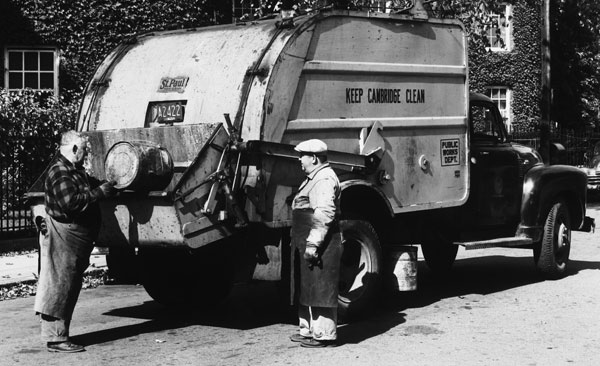
Manager’s Agenda #4. Transmitting communication from Robert W. Healy, City Manager, relative to a report from the Department of Public Works that summarizes the results from a feasibility study regarding a possible pilot program for curbside food scraps collection from residents for composting.

Honey WagonFrom the Executive Summary:
If implemented, the pilot will run one day a week for one year. We estimate 2 tons per day of food and 124 tons per year. This assumes 800 households generating 10 pounds of food scraps per week with an 85% participation rate and 70% setout rate. To ensure an efficient pilot route, we will choose a neighborhood within one collection day. We would target a range of housing types including single-family homes and residential buildings with up to 12 units… Households participating in the pilot will receive a kitchen scrap container and a year’s supply of 3-gallon compostable bags to line the container…. If the pilot is successful, a voluntary citywide program would be phased in by collection day to get enough participation among households to achieve minimum route density.

This is an exciting development. Many of us will continue to compost organics in our backyards, but if the pilot is successful and the program can eventually be expanded to a citywide program, this will be a great service to those who either cannot set up composting at home or who may prefer an organics collection service. Bring back the honey wagon! What was old is new again.

Applications and Petitions #2. A zoning petition has been received from Zevart M. Hollisian, Trustee of Garabed B. Hollisian Trust and L-Z Realty Trust and Seth D. Alexander, President, MIT Investment Management Company to amend the Zoning Ordinance and Map by extending the Cambridgeport Revitalization Development District from Green Street out to Massachusetts Avenue in the area adjacent to Blanche Street; said petition includes a map and a commitment letter.

This is essentially the same petition that was filed last March together with the committments subsequently made in July prior to the expiration of that petition. The main argument then for why the petition should be allowed to expire was that the Central Square Advisory Committee 2011/2012 was still in the process of formulating its recommendations. That process is now complete, so the time is right to revisit this proposal.

Memorandum from the Central Square Advisory Committee 2011/2012 on its Final Recommendations

Central Square and Osborn Triangle Plan & Recommendations

Discussion of Recommendations Presentation

Parking Lot Reuse Presentation

Communications #1. Open Meeting Law Complaint filed by Tom Stohlman.

Order #9. That the City Clerk, in consultation with the Law Department, draft a response regarding an Open Meeting Law complaint received on Dec 4, 2012 for the City Council’s consideration at its Dec 17, 2012 City Council meeting in order to meet the Dec 21, 2012 deadline.   Mayor Davis

It is doubtful that there is any merit to the claim that the Open Meeting Law was violated in the drafting of last week’s Order on the appointment of Rich Rossi as City Manager starting next July. As City Clerk Donna Lopez clearly explained last week, the Order was drafted by a minority of City Council members and was submitted to the City Clerk who then circulated the Order to provide other councillors the opportunity to sign on as cosponsors. This is standard procedure. There were neither meetings involving a majority of councillors nor were there "serial meetings." It is likely that some councillors had conversations on the topic, but the intention of the Open Meeting Law has never been to require elected officials to avoid all conversation except when meeting in a public session.

Order #4. That the City Manager is requested to report back to the City Council on the cause and other details of the power outage on Nov 29, 2012.   Mayor Davis

The best report I’ve seen so far is by John Hawkinson of MIT’s The Tech.

Communications and Reports from City Officers #1. A communication was received from Mayor Henrietta Davis transmitting a copy of the Silver Ribbon Commission Report.

There report is available here. [Thanks to the Mayor’s Office for posting the 50-page original document!] – RW

December 3, 2012

Enjoying? the Concord Avenue “raised bike lanes”

The Cambridge City Council meeting on December 3, 2012 is to address issues of debris on the Concord Avenue “raised bike lanes”. These replaced conventional bike lanes at street level. I put the term “raised bike lanes” in quotes because a bikeway behind a curb is not a bike lane. By definition, a lane is at street level, so it is possible to merge to and from other lanes. Rather, this is a nonstandard bicycle path.

This post supplements comments which I posted on my own blog before Concord Avenue was reconstructed. The photos here are stills from video shot during a ride westbound at mid-day on November 20, 2012, with moderate motor traffic and very light bicycle traffic.

First photo: Crosswalk just west of the Alewife Brook Parkway rotary is backing up motor traffic. This already generates traffic jams with light bicycle traffic. The City expects the bikeways to attract more cyclists and to lead to a major increase in bicycle traffic.

Crosswalk backs up traffic on Concord Avenue

Crosswalk backs up traffic on Concord Avenue

Next photo: The westbound bikeway crosses 8 streets and 24 driveways in 3000 feet. The most persistent hazard on the westbound bikeway is of “right hook” and “left cross” collisions. The van in the photo not only is turning across the bikeway; it also might be hiding another vehicle preparing a left turn from ahead. The bikeway places bicyclists where they are defenseless against these threats. I say more about them, and how to avoid them, in my earlier blog post.

Right hook and left cross threat on Concord Avenue bikeway

Right hook and left cross threat on Concord Avenue bikeway

Next — bus stop. When the bike lanes were at street level, bicyclists could pass a stopped bus on the left, or wait behind it. Motorists also usually could pass a stopped bus. Passing would have been even easier with bus turnouts on the westbound side, where there is only one travel lane. Now that the roadway has instead been narrowed, converting the conventional bike lanes into “raised bike lanes”, buses must completely block the travel lane, and passengers getting off a bus step down directly into the path of bicyclists. A 2007 research study in Copenhagen showed an increase in bicyclist-pedestrian collisions of 17 times, and of injuries of 19 times, when bus stops were placed outside bikeways like this. More about that study.

Bus stop on Concord Avenue, with green paint

Bus stop on Concord Avenue, with green paint

That study was published well before construction on the Concord Avenue bikeway began. Not only that, the City’s bicycle coordinator repeatedly points to Copenhagen as a model of what Cambridge should do.

To resolve conflicts between bicyclists and passengers descending from buses, the City first painted bicycle markings. Those markings, however, suggest that bicyclists have priority, and these markings also may not be directly in front of a bus’s door when it opens, to warn the passengers. At some later time, green carpet painting was added. This is normally used to indicate where motorists yield to bicyclists (see Federal Highway Administration interim approval), but here it is intended to indicate where bicyclists must yield to pedestrians, a confused and contradictory message. This bus stop is at a driveway. Traffic has worn away some of the green paint and you can see the bicycle marking which was painted over.

Bicycle marking under green paint at bus stop on Concord Avenue

Bicycle marking under green paint at bus stop on Concord Avenue

One problem to be discussed at the City Council meeting is that snow clearance is not practical on the westbound bikeway, because of its repeated ups and downs. Ice also puddles there. Here’s a photo from another blogger, dr2chase, showing winter conditions on the westbound bikeway. dr2chase’s blog has many more photos.

dr2chase's photo of winter conditions on the Concord Avenue bikeway westbound

dr2chase’s photo of winter conditions on the Concord Avenue bikeway westbound

dr2chase also has made the point that snow clearance is much more practical on the eastbound bikeway, which has only one driveway entrance in its entire length. Here is his photo illustrating that:

drchase's photo of the eastbound bikeway in winter

drchase’s photo of the eastbound bikeway in winter

The bikeway on each side is designated as one-way. People are likely to use both of them for two-way travel, and not only in snow season, because a cyclist must stand in the street to lift the bicycle over the curb of the eastbound bikeway at most locations. Also note the seam between asphalt and concrete running down the middle of the photo above. It is intended to separate bicyclists from pedestrians. It won’t, especially with two-way bicycling, and over the years, it will deteriorate so it traps bicycle wheels. dr2chase and I have both made the point that a properly-designed, designated two-way bikeway on the south side of Concord Avenue, adjacent to Fresh Pond Park, would have made good sense, connecting with the existing bikeways in the park and crossing only one driveway in its entire length — at a signalized intersection. I also would have liked to keep the street at its previous width, with street-level bike lanes, to allow efficient through travel and make it possible to reach the eastbound bikeway without lifting a bicycle over a curb.

The next photo illustrates the crossing-the-street issue. Note the driveway at the right rear, and that there is no break in the curb on the far side of Concord Avenue. To cross without stopping in the street, and to avoid having to double back, cyclists will most likely ride eastbound in the westbound bikeway. That is illegal and hazardous: motorists pulling out of side streets and driveways look in the opposite direction for traffic.

The mailbox adjacent to the 5-foot-wide bikeway adds a nice touch as well. Nick it with your handlebar, and you go down hard. Even without such obstructions, 5 feet is minimal for one-way travel. This mailbox is one of a large number of fixed-object hazards adjacent to the bikeway.

Mailbox, and curb on far side of Concord Avenue

Mailbox, and curb on far side of Concord Avenue

Not all hazards are fixed-object hazards. There are these trash barrels.

Trash barrels on westbound bikeway on Concord Avenue

Trash barrels on westbound bikeway on Concord Avenue

Behind the trash barrels, you may have noticed a car discharging passengers. A cyclist who regularly rides Concord Avenue reports that delivery vehicles also now stop in the bikeway.

Car stops in bikeway to discharge passengers, on Concord Avenue

Car stops in bikeway to discharge passengers, on Concord Avenue

My next photos show what I call the X-merge, or double-cross merge.

Normal traffic law requires a driver to maintain a constant lane position when another driver is overtaking. Here’s an excerpt from the Massachusetts law [Link updated March 1, 2025. The section has been amended but there has been no change to this wording.]:

Except as herein otherwise provided, the driver of a vehicle passing another vehicle traveling in the same direction shall drive a safe distance to the left of such other vehicle and shall not return to the right until safely clear of the overtaken vehicle; and, if the way is of sufficient width for the two vehicles to pass, the driver of the leading one shall not unnecessarily obstruct the other.

Bicyclists may overtake on the right, according to another section of the law [link updated March 1, 2025; no change in this wording.]:

…the bicycle operator may keep to the right when passing a motor vehicle which is moving in the travel lane of the way…

When a bicyclist is directed to merge from right to left at an arbitrary location, and a motorist to merge from left to right at the same location, they are both violating the law. Green paint here is used to direct cyclists and motorists to operate illegally.

X-merge on Concord Avenue

X-merge on Concord Avenue

I avoided right-hook threats by merging in behind the stopped car so the next vehicle turning right could safely pass me on the right.

Avoiding the X-merge on Concord Avenue

Avoiding the X-merge on Concord Avenue

Before Blanchard Road, a traffic island narrows the roadway. The bike lane, between the through travel lane and right turn lane, is too narrow to allow safe clearance on both sides. Note in the photo below that the narrow median on the far side of Blanchard Road allows much more room to the left of the bike lane. The traffic island predates the reconstruction: the bike lane has been shoehorned in by narrowing the other lanes. Concord Avenue is wide enough to accommodate turning traffic without the island’s being so wide.

Wide traffic island at Blanchard Road narrows bike lane on Concord Avenue

Wide traffic island at Blanchard Road narrows bike lane on Concord Avenue

Well, enough. You get the idea. I’ll finish with a couple of quotes. Here’s one from MarkS, commenting on dr2chase’s blog post:

I don’t know why they wasted the time and money to put these tracks in in the first place. I find a bike lane much more convenient, and in some ways safer — clearly safer than that abomination on the north side of Concord Ave — the “outgoing” side. And, if ever we decide to re-design the situation, the expense of doing so will be significantly — and that’s an understatement — more than it would be to just re-paint the lines where the bike lane would have been.

Here’s another quote, from dr2chase:

…the west-bound side is about the most ineffective botch I have ever seen. But the eastbound side is quite nice (with the exception of the scary-high curbs). One extremely-low-traffic intersection, no driveways, hence none of those risks, and so wide that (with current bike/ped traffic levels) there is little harm in riding the wrong way on the good side. Technically illegal, but vastly safer, and I cannot fault someone for making the safer choice.

I agree! And have a look at the video online!

Save

Save

Save

March 19, 2012

Getting Down to Business – Mar 19, 2012 Cambridge City Council Agenda Highlights

Getting Down to Business – Mar 19, 2012 Cambridge City Council Agenda Highlights

There can be little doubt that this meeting is the most serious meeting so far this year and possibly for this entire year. Front and center on the agenda is City Council Order #7, cosponsored by seven of the nine city councillors, calling for an extension of the City Manager’s contract (through mid-2013) and a commitment to begin consideration of how the process of succession might be conducted should this be the final contract extension for City Manager Robert W. Healy. There has been no recent public statement from Mr. Healy regarding his wishes for any additional contract extension, but a short-term extension like the one proposed seems consistent with statements made in recent years. It is noteworthy that seven of the nine city councillors had the good sense to grant a contract extension. The two councillors who did not sign on to this Order are Councillor Kelley (who has been a vocal opponent of Mr. Healy since long before his time as a councillor) and Councillor Reeves (speculation encouraged).
[Update: City Manager Robert Healy has now stated that he will retire at the end of this extended contract – in mid-2013.]
The relevant Order is this:

O-7     Mar 19, 2012
COUNCILLOR MAHER, COUNCILLOR CHEUNG, COUNCILLOR DECKER, VICE MAYOR SIMMONS, COUNCILLOR TOOMEY, MAYOR DAVIS, COUNCILLOR VANBEUZEKOM
WHEREAS: City Manager Robert Healy’s current employment contract with the City of Cambridge expires on Sept 30, 2012; and
WHEREAS: The contract contains a notification provision which needs action by the City Council or Mr. Healy on or before Mar 31, 2012; and
WHEREAS: As a result of Mr. Healy’s long tenure as City Manager, the City of Cambridge has not undertaken a search for a new City Manager for over thirty years; and
WHEREAS: It is imperative to the overall stability of the City of Cambridge that the City Council develop both a comprehensive short-term and long-term succession plan that will assist the City Council in their ongoing goal of providing fiscal stability and thoughtful strategic planning and any short-term plan should be in place before the FY 2014 budget process begins; now therefore be it
ORDERED: That the City Council amends the expiration date of the City Manager’s current employment contract to June 30, 2013 which coincides with the fiscal FY 2013 year-end; and be it further
ORDERED: That all other provisions of the employment contract remain unchanged; and be it further
ORDERED: That the City Council’s Government Operations and Rules Committee, with the assistance of the City Manager, begin the process of developing comprehensive short-term and long-term succession plans. Such plans shall include timelines and outline opportunities for input from the community including residents, businesses, institutions and City staff. Once developed, such plans shall be presented to the full City Council for final consideration.

Regardless whether any addition contract extensions occur in the future, there is wisdom in this City Council developing some kind of vision of how the City will one day, perhaps next year, make the difficult transition to a new City Manager after three decades of extraordinarily competent leadership. Let’s just hope that when the time comes this City Council or a future City Council is up to the task.

Elsewhere on the agenda:

Manager’s Agenda #1. Transmitting communication from Robert W. Healy, City Manager, relative to the block rates for water consumption and sewer use for the period beginning Apr 1, 2012 and ending Mar 31, 2013.

The proposal is that the water and sewer rates remain unchanged for the coming year – the 2nd consecutive year of 0% increases. The future may not be as bright with projected water rate increases in the coming few years of 1.1%, 0.2%, 1.3%, and 2.0% but more significant projected sewer rate increases of 5.8%, 9.1%, 6.0%, and 10.2%. Sewer costs are currently about 72% of a typical water/sewer bill, so escalating sewer rates will have a significant impact down the road even as the water rates remain relatively stable.

On The Table #2. Transmitting communication from Robert W. Healy, City Manager, relative to a request from Boston Properties Limited Partnership ("Boston Properties") for the modification of two existing open space restriction covenants on buildings located at Four and Five Cambridge Center in connection with the creation of a new 47,000 square foot urban park and new open space restriction covenant for a net gain 28,853 square feet of public open space.

The proposal introduced several weeks ago by Boston Properties (to reduce the rooftop garden on the Kendall Square garage in exchange for greatly extending the agreement to maintain the garden and landscaping additional open space in the Kendall Square MXD District) was Tabled in order to allow more time for public process and, presumably, negotiation. Much of the public comment to date has been resoundingly negative, and there has been at least one proposal (from the East Cambridge Planning Team) to link any changes to the existing rooftop park to the provision of comparable space on adjacent buildings and a commitment to build the housing mandated by zoning guidelines. There are efforts to lure prize tenant Google away from Cambridge should this matter be long delayed, so there is some pressure on the City Council to resolve this soon and, hopefully, amicably for all affected parties.

Communications #3-32 and #36-111. A barrage of computer-generated petitions regarding the proposed reconfiguration of Community Schools programs associated with the temporary relocation of the King School and the programs housed therein.

It took me all of about a week to grow tired of the computer-generated communications that these "change.org" petitions produce – all identical lemming-like statements of dissatisfaction over whatever the flavor-of-the-week gripe happens to be. There are aspects of the proposed Community Schools reconfiguration worthy of discussion, but advocacy by the pound is thoroughly unappealing. Several well-considered letters from a few thoughtful individuals carry so much more weight than 76 sheep clicking "send" on a petition-generating website.

Much more entertaining are the following communications from the Odd Wizard of Franklin Street.

Communication #34. A communication was received from Peter Valentine regarding activity throughout the nation and territories where the national interests are involved.

Peter urges the following: To all True Americans from Peter Valentine, National Officer In Charge under the authority of a Constitutional State of "Imminent Danger That Will Not Admit Delay" 37 Brookline St., 3/9/2012. Orders that all governments in the United States of America be it Town, City, State or National implement a Department of Constitutional monitoring, investigation and corrective action to whatever degree necessary pertaining to any rights violations that a citizen believes a government may have perpetuated against a citizens’ constitutional rights. And further to all True Americans be it known that the National Officer In Charge is aware of all subversive activity throughout the nation and territories where the national interests are involved whether it be enemies who have infiltrated the government, the security forces or to undermine the security and well being of society in general. As Above, So Below. The term True American does not have to be defined because if you are a True American, You have The intelligence to Know What It Means.

Communication #113. A communication was received from Peter Valentine regarding the way to end all the world’s problems is for everyone to become creative instead of average and or despotic.

Peter urges the following: To all True Americans from The National Officer In Charge, under the authority of a "Constitutional State of Imminent Danger That Will Not Admit Delay", citizen Peter Valentine, 37 Brookline St. 3/11/2012. The Officer In Charge sends the Directive forward that the way to end all the world’s problems if for everyone to become Creative instead of Average and or Despotic.

Resolution #1. Retirement of Darleen G. Bonislawski from the Election Commission.   Mayor Davis

Darleen Bonislawski has served honorably as an Election Commissioner since 1988 (24 years). As one of the few residents who ever goes to meetings of the Election Commission, I’ll note that Darleen has been the most outspoken commissioner advocating for members of under-represented communities to register and to vote. Her successor must be appointed by April 1 from a list of three persons nominated by the Cambridge Democratic City Committee. Two of those nominees, Tom Stohlman and Larry Ward, are superb choices – either of whom would be an excellent choice to succeed Darleen.

Order #3. That the City Manager, in conjunction with the Community Development Department, is requested to investigate the improper leases and rental of owned affordable housing units.   Councillor Reeves

What a revelation. It’s somewhat reminiscent of the days of rent control when property owners were constrained in what they could legally charge for rent, but many tenants were earning great money (including a former mayor) and other tenants were subletting their rent-controlled apartments for substantially more than the maximum legal rent. I guess it just goes to show that we’re all good capitalists at heart. That includes many people in subsidized housing who are expert at being "poor on paper" in order to qualify for taxpayer-supported cheap housing, and apparently a few ultra-capitalists who are now using their taxpayer-supported housing as a tradable commodity. All Hail Marx and Lenin here in the Peoples Republic!

Order #8. That the City Manager is requested to work with the Information Technology Department and the Government Operations and Rules Committee to look into the feasibility of recording all roll call votes online and report back to the Cambridge City Council.   Councillor Cheung

As the ultimate Council observer, I endorse this wholeheartedly. It does, however, seem rather odd that the City is so enslaved and choked by its own technology that the IT Department is required when all that is needed is a simple annotation indicating how people voted. This is already done for some items voted by the City Council. – Robert Winters

March 5, 2012

Cambridge City Council subcommittees for 2012-2013

Filed under: Cambridge,Cambridge government,City Council — Tags: , , — Robert Winters @ 8:49 pm

City Council subcommittees for 2012-2013

Committee Members Staff
Ordinance Maher (Chair), (committee of the whole) Lopez, Crane
Finance Decker (chair), (committee of the whole) Lopez, Crane
Government Operations and Rules Maher (Chair), Cheung, Simmons, Toomey, vanBeuzekom Lopez
Transportation, Traffic, and Parking vanBeuzekom (Chair), Decker, Simmons Lopez
Neighborhood and Long Term Planning Cheung (Chair), Reeves, vanBeuzekom Lopez
Housing Decker (Chair), Kelley, Reeves Lopez
Economic Development, Training, and Employment Toomey (Chair), Cheung, Reeves Lopez
Public Safety Kelley (Chair), Simmons, Toomey Lopez
Human Services Simmons (Chair), Kelley, Reeves Lopez
Public Facilities, Art, and Celebrations Reeves (Chair), Cheung, Maher Crane
Cable TV, Telecommunications, and Public Utilities Cheung (Chair), Decker, vanBeuzekom Crane
Veterans Kelley (Chair), Decker, Toomey Crane
Claims Toomey (Chair), Maher, Simmons Cosgrove
University Relations Reeves (Chair), Maher, vanBeuzekom Lopez
Community Health Decker (Chair), Toomey, vanBeuzekom Crane
Environment vanBeuzekom (Chair), Cheung, Kelley Crane
Civic Unity Simmons (Chair), Maher, Kelley Crane

September 15, 2011

Concord Avenue, Under Construction

I just rode Concord Avenue last Sunday to see what was happening there.

I had thought that the construction project would have been completed by now, but it isn’t.

The image below is of the east end of the section under construction. I find a bit of irony here in that the “Bikes May Use Full Lane” sign is placed at the start of a project which intends to get bicycles off the road, and also it is nonstandard — diamond-shaped like a warning sign which is supposed to be yellow, but white like a regulatory sign, which is supposed to be rectangular (as with speed-limit and no parking signs). The message is a regulatory message: it is law.

Looking west at the east end of the Concord Avenue section under construction

Looking west at the east end of the Concord Avenue section under construction

Construction barrels divide the narrowed roadway into two lanes, rather than the three planned for when construction is complete. As the westbound bikeway is incomplete, I rode west on the roadway. Motorists still were able to overtake me without leaving their lane, as they were when the roadway was wider, with three travel lanes and a bike lane on either side. I was passed by a number of cars, no problem. I had one conflict with a driver who moved out of a side street into my path. Such conflicts will be much more common when bicyclists are riding in sidewalk space.

The road surface was very bumpy because the street has not yet been repaved. The effort is going into construction of the bicycle sidepaths at this time.

I shot video of my rides. It’s HD video and you will want to view it full screen to get all the details. This is the link to the video of my westbound ride. And here is my eastbound ride.

One other thing I hadn’t expected is that the south-side (eastbound) path was almost completely empty, except for me, though it was nearly finished, and unobstructed — on a warm, sunny Sunday afternoon when there was heavy bicycle and pedestrian traffic in Fresh Pond Park and on the Minuteman path.

I can say that if much traffic does appear on the south-side path, the situation will be very confused. There is no buffer between the 5′ wide bikeway (closer to the curb) and the wider walkway away from the curb. There was supposed to be a 2-foot-wide buffer, as I recall. Also, the concrete pavement of the pedestrian section, farther from the curb, is smoother. The bumpier asphalt pavement adjacent to the curb is supposed to be for eastbound bicyclists, in defiance of AASHTO guidelines, which require a 5′ spacing or a barrier, and also in defiance of normal path and road rules, which require riding on the right side. The City’s scheme would have eastbound bicyclists riding on the left side of the combined bikeway and walkway. Meanwhile, there also will be westbound bicyclists using this path to avoid the much worse path on the other side of the street, and probably keeping to the right as is usual.

As the path is behind a high curb, bicyclists who want to cross Concord Avenue will have to wait at the crosswalks rather than to merge into the roadway. At the few crosswalks, there is no waiting area (for example, at 1:24 in the eastbound video). Because the bikeway is between the walkway and the street, bicyclists and pedestrians who are waiting to cross the street will block the bikeway, and other bicyclists will have to divert onto the walkway.

As the concrete pavers of the pedestrian section and the asphalt of the bicycle section age and settle, a step could develop between them, just as on the parts of the Charles River paths, widened with asphalt next to the old stone retaining wall along the riverfront. Many bicyclists have gone down as a result.

Many aspects of the Cambridge bicycle program can be described as ideologically driven, and defying national and state design standards. Placing a longitudinal seam along a bikeway, and directing traffic to keep left, are merely incompetent.

Other than what I have described in this post, the project looks as though it will turn out as I expected, with the foreseeable problems I’ve already described in my earlier post; the right hook and left cross conflicts, inability to cross to the south side at most locations without dismounting in the street to lift the bicycle over a curb; resulting wrong-way riding on the north side, etc.

The party line about the Concord Avenue project, which I have in writing from two City employees (here and here) and verbally from a member of the Cambridge Bicycle Committee, is that “bicyclists will be riding in exactly the same place as they are now.” This statement turns a blind eye to the encouragement of wrong-way riding, and the keep right/keep left confusion. It ignores bicyclists’ crossing and turning maneuvers, and motorists’ being trapped by the curbs and forced to turn across the path of bicyclists; it denies that motorists block sidepaths so they can see approaching traffic in the street. Saying that “bicyclists will be riding in exactly the same place as they are now” is like saying that a bird in a cage, hanging in a tree, is in exactly in the same place as a bird sitting in that tree and free to fly off.

What really burns me up is that the City employees designing bicycle facilities appear to have no concept of how bicyclists actually are going to use them, or of the potential hazards. It’s all about “build it and they will come” and that means, build just anything they think will attract novice cyclists and children, and to hell with design standards and safety research. I see shoddy and incompetent mimicry of European designs, and astonishing hubris. So far, the Concord Avenue bikeway is half built with one side completely open, and very few bicyclists have come, except for me, and I was there on a discovery tour.

Save

Save

May 20, 2011

Response to City officials’ comments about Concord/Follen

Robert Winters has posted a comment (#3 here) to my post about bicycling issues on the May 16 City Council agenda. Robert quotes Assistant City Manager for Community Development Brian Murphy and Traffic, Parking & Transportation Director Susan Clippinger about Follen Street and Little Concord Avenue. Their response, by way of the City Manager, is addressed to the City Council at next week’s meeting.

Their response (again, in comment #3 here) addresses some of the issues with the Follen Street/Concord Avenue installation, and reflects some progress.

Serious design issues, however, will still remain:

  • The configuration still has the same blind corners.
  • Because of the location of the curb cut into the brick plaza, bicyclists traveling away from the Common must still swerve to the right, toward approaching motor traffic, to reach the curb cut at the crosswalk on the far side of Follen Street. Bicyclists entering from the brick plaza are still close to a wall which also obscures motorists’ view of them.
  • Motorists approaching on Follen Street still won’t have a stop sign — see this Google Street View (and still not in 2020)– despite the blind corners.
  • The contraflow bike lane adjacent to wrong-way parking remains.
  • There is another blind corner at the Garden Street end of the pedestrian plaza, particularly for cyclists who continue toward the Radcliffe Quadrangle on the sidewalk (and many do, though that is inadvisable).
  • The “bike box” on Concord Avenue leads to more confusion than anything else, as described here. Also, many cyclists ride east on the north sidewalk, so they can access the plaza directly, posing a risk of head-on collisions with westbound cyclists and pedestrians at the blind corner between the sidewalk and the plaza.

Contraflow bicycle travel would be safer if parking were removed from one side of Follen Street — however, the public insists on using public street space for private car storage. As a bicycling advocate and former Cambridge resident who owned a (rarely used) car and had no other place to park it than the street, I can see both sides of this issue. It is not going to go away. The people who laid out Cambridge’s streets could not foresee the deluge of private motor vehicles that would descend on the city, and had no plan either to accommodate it or to forestall it.

I do think that a very significant safety improvement could be made without removing parking, by reversing the direction of one-way motor traffic on Follen Street and Little Concord Avenue. Then cyclists headed toward the blind corner would be going in the same direction as motorists. The motorists would be going very slowly here, and cyclists could easily merge toward the center of the roadway. A curb cut into the plaza in line with the center of the roadway would avoid cyclists’ having to swerve right. This curb cut would lead cyclists traveling toward the Common to the right side of the street.

A contraflow bike lane could then be installed on the south side of Little Concord Avenue, but it would still be adjacent to wrong-way parking. I’d rather see shared-lane markings far enough from parked cars to allow a motorist to start to exit a parking space without running head-on into a cyclist or forcing that cyclist into oncoming traffic. One-way, slow streets where bicyclists are allowed to travel contraflow are common in Germany, without bike lanes, and research has demonstrated their safety.

As to Murphy’s and Clippinger’s comments:

Motor vehicle volumes on the street are very low and most drivers are ones who live there and use the street regularly. The contraflow lane was installed to improve safety for cyclists by creating a dedicated facility for them to ride in and through the presence of pavement markings to remind motorists that bicyclists are traveling there.

The low motor-vehicle volume argument is an example of what I call “bean counter” safety analysis. I have heard the same argument before from Cara Seiderman, in connection with the wrong-way contraflow lane on Scott Street. This approach offers cyclists and motorists only statistical comfort, leaving them defenseless against actually preventing a crash through their own actions — as in “well, I can’t see over the SUV parked in front of my car, but probably no cyclist is coming so I’ll pull out.”

The bike lane does serve as a buffer to help prevent collisions between cars and other cars, but it doesn’t pass the test of preventing collisions between cars and cyclists. The comforting words “dedicated facility” don’t actually describe how it works in practice. Reminding motorists that bicyclists are traveling in the bike lane doesn’t count for much if the motorists can’t see the bicyclists.

Clippinger describes a safety analysis which looked at generalities about traffic volume. The claim that the dedicated facility was installed to improve safety may describe intention, but it does not describe either the design, or the outcome. This is a crash hotspot, remember. I have described design issues, and some solutions that look rather obvious to me. The city, as usual, installed a boilerplate bike lane design without much insight into whether it actually would be functional and safe.

May 16, 2011

About bicycling issues on City Council agenda tonight, May 16, 2011

A cyclist and a motorist approach the blind corner at Concord Avenue and Follen Street

A motorist cuts off a cyclist at the blind corner of Concord Avenue and Follen Street

The city's own picture of this scene shows a cyclist happily steering straight toward a curb.

A picture of the same scene from the City's Web site shows a cyclist happily steering straight toward a curb, which is cropped out of the picture.

Looking from the opposite direction, this is the path a bicyclist must take, swerving toward traffic to reach the curb cut.

Looking from the opposite direction, this multiple-exposure photo shows the path a bicyclist must take, swerving toward Follen Street traffic to reach the curb cut at the crosswalk.

This post attempts to shed some light on agenda items on tonight’s City Council agenda.

The quoted sections are from another commenter. I’m not sure I know how to reach him, and time is pressing. I don’t know whether I have permission to use his name, so I won’t. The unindented paragraphs  are my own. We’ll start with the other person who commented.

Two of the three items on the city council agenda are interesting examples of problems related to bicycle infrastructure that has been implemented over the past several years.  The third is simply a request to fill potholes, but includes an ignorant comment about bicycles needing to ride near the curb (not true according to Massachusetts law or Cambridge ordinance).

That is agenda item O-7 on the page linked here

The first bicycle facility problem is a contra-flow lane through a blind corner where motorists have no expectation that there will be contra-flow traffic of any sort as they round the corner on a one-way street.

http://bit.ly/iAHCfU

That is agenda item O-3 on the page linked here.

The street view is looking south on Follen Street as it intersects (Little) Concord Avenue.  The bike lane crosses in a contraflow manner from left to right, and then continues across the small brick plaza to the right to join with Garden Street and the continuation of Concord Avenue.  The intersection just beyond the plaza is the same one where Cambridge has installed a bike box critiqued by John Allen

(http://bit.ly/jQN595).

The contraflow bike lane is adjacent to wrong-way parking, another odd feature of this installation — see this for a description and explanation of wrong-way parking:

http://bikexprt.com/bikepol/facil/lanes/contraflow.htm#scottst

Upon reaching the corner, bicyclists have to ride out past a stop bar and stop sign before they can see around the corner. A stop sign requires two actions, a stop and a yield. The yield is what actually prevents a collision — but it is only possible where you can see conflicting traffic.

Many if not most of the bicyclists approaching this intersection are Harvard students headed up to the Radcliffe quadrangle. Are we to assume that they aren’t bright enough to figure out that they must yield? The problem is that nobody ever instructed them, and many have little bicycling experience as they suddenly find themselves dependent on a bicycle for transportation. Also, the stop bar isn’t where there’s anything to yield to unless a pedestrian happens to be crossing — it encourages running the stop sign, sort of like traffic ju-jitsu: aha– fooled ya!.

See Google Street View looking toward the stop sign:

http://tinyurl.com/4yfz9bc

I have a discussion of this contraflow bike lane in the page linked below this paragraph. The third photo down the page shows the stop sign. I prepared the page linked below years ago, shortly after the installation. This was clearly going to be a problem location.

http://bikexprt.com/massfacil/cambridge/harvardsq/litlconc.htm

The curb ramp on the far side of the intersection is located at the end of the crosswalk rather than in line with the bike lane. Bicyclists must ride toward approaching traffic to reach the ramp.

Bicyclists coming in the opposite direction off the little pedestrian plaza are hidden by a wall and subject to similar risks. This entire treatment is a prime example of Cambridge’s principle of Design by Wishful Thinking.

The second problem is at a rather unremarkable intersection, so it is not clear to me why there would be issues.

See Council Order O-19 on the page linked here.

http://bit.ly/kQWgBQ

The street view is looking south on Ellery Street as it approaches Broadway.  Ellery is a narrow one-way street with a bike lane.  Traffic is typically slow, but can be heavy at rush hour.  Broadway is a two-way narrow connecting through street with parking and no bicycle infrastructure in this area.  Traffic typically runs about 25-30mph, slower and heavier at rush hour.  The intersection is also at the corner of a local public high school campus.  Neither street is difficult to cycle on if you have at least modest traffic experience.

There is a flashing yellow and red overhead signal indicating a stop sign for Ellery Street entering from the north.  I tried to find data related to the several accidents cited, but did not see anything apparent on the Cambridge city web site.  I can speculate that most of the car/bike accidents are probably due to scofflaw behavior — either bicyclists in the Ellery bike lane not heeding the stop sign as they continue across Broadway, or wrong-way riders in the Ellery Street bike lane illegally approaching Broadway from the south.  Also likely would be standard right hook, left cross, and failure to yield collisions caused by motorists, but I don’t see why those would be any worse at this intersection.

I see a double-whammy right-hook provocation for bicyclists headed south on Ellery Street, in that the bike lane on the far side of the intersection is to the left of parking (and in the door zone, as is usual in Cambridge), while the bike lane on the near side is at the curb and carried all the way up to the intersection. So, bicyclists are encouraged to overtake motorists on the right, then merge left inside the intersection where motorists turn right.  I think that the high traffic volume and prevalence of high-school students probably also account for the number of crashes. There probably are scofflaw crashes too. Yes, it would be very interesting to see details so as to get a handle on what is actually happening here.

I’m not looking for any answers, but I thought people on this list might be interested in what Cambridge lawmakers are thinking.

« Newer PostsOlder Posts »

Powered by WordPress